Facial tension: why it builds up and how to release it
Share
Do you wake up with a tired jaw, feel a dull ache creeping into your temples by the afternoon, or notice that your forehead is still tight long after you've closed your laptop? Then you know what facial tension feels like, even if you've never put a name to it yourself. It builds up when the muscles in your face and jaw keep working when they should be resting, often together with tension in your neck and shoulders, and it creeps in so slowly that most of us don't notice it until it makes itself known. The tension usually mirrors the rest of our lives, from stress and concentration to sleep and habits we rarely think about, and that's exactly why it's something you can influence.
Here we take a deeper look at what facial tension really is, why it happens, what triggers it and how you can help your muscles let go, with massage, breathing, warmth and face taping as part of your evening ritual.
What is facial tension?
Your face has two different groups of muscles, and they tense up in different ways. The first is the muscles of expression, such as the forehead muscle, the muscles between the brows and the ring of muscle around the eyes. They attach directly to the skin, which is what lets them shape our expressions, and it's also why their tension shows. When they work harder than they need to, they draw the forehead, brows and the area around the eyes together, giving the face a more strained look.
The second group is the chewing muscles, above all the masseter along the angle of the jaw and the temporalis above the ear. The masseter is one of the strongest muscles in the body for its size, and its tension is felt more than seen. It can feel like post-workout soreness in your face, and that makes sense, because a muscle that rarely gets to rest becomes tired and sore just like any other.
The two groups are connected, both to each other and to the rest of the body. Tension in the jaw easily spreads to the temples and forehead, and tension in the neck can cause similar symptoms in the jaw, face and head. In other words, the face is rarely an isolated part, but a mirror of how the whole body is doing.
Why does facial tension happen?
When we're stressed, focused or worried, the body tenses its muscles as part of getting ready to act. It's a natural response that's meant to be brief, but in everyday life the next email, the next deadline and the next thought arrive before the muscles have had a chance to let go, and so that low-level tension stays on for hours. Stress, worry, low mood and poor sleep can all make the muscles tenser than usual.
What makes facial tension so sneaky is that we rarely feel it while it's happening. Few of us notice that we pull our brows together when we read or clench our jaw while driving, and so the tension eventually becomes a habit the muscles repeat on their own, long after the stressful moment has passed.
Common triggers of facial tension
These are the most common culprits, and a few of them might surprise you:
- Clenching during the day. Your teeth should only touch when you eat or swallow, and the rest of the time your jaw should rest with a small gap between the teeth. Many of us still keep our teeth together for much of the day without knowing it, and daytime clenching can be linked to stress.
- Grinding or clenching at night. It mostly happens as sleep shifts from deep to light, and stress, worry, alcohol, smoking and snoring are among the things that can play a part. It's common to wake up with an ache in the temple or across the forehead.
- Your tongue. A tongue pressed against the palate or the teeth holds the jaw in a tense position, and it's something very few of us think about.
- Concentration and screens. We pull our brows together when we think and squint at the screen, often for hours on end, which keeps the muscles between the brows and around the eyes working.
- Neck and posture. When the head pushes forward towards a screen or phone, the neck has to work harder, and tension in the neck and throat can cause symptoms all the way up into the jaw, face and head.
- Small habits. Chewing a lot of gum or biting your nails, pens, lips or the inside of your cheek puts more load on the jaw than you might think.
- Too little sleep. Your muscles relax when you sleep, so short or restless nights give them less time to recover.
Signs you're holding tension in your face
Facial tension often shows up in ways we don't immediately connect to the muscles:
- A dull ache in the temples or across the forehead, often as soon as you wake up.
- A tired or sore jaw, especially when you chew.
- Tender teeth, or teeth that wear down faster than usual.
- Clicking sounds from the jaw when you open or close your mouth.
- Tension headaches that feel like a band around your head.
- A forehead or brows that feel tight, and a face that looks more strained than you feel.
Symptoms from the jaw joints and jaw muscles are common, and they affect about one in ten adults, so if you recognise yourself here, you're far from alone.
How to release facial tension
Since facial tension is largely a habit, it comes down to two things: helping the muscles relax right now, and teaching them a new resting position over time.
1. Find your jaw's resting position
Your lips can be closed, but your teeth should be slightly apart and your tongue resting softly in your mouth. A gap of a few millimetres is enough for the jaw to relax, and a simple trick is to remind yourself to "drop your chin". If the position is hard to find, hum the letter M for a moment and your jaw will settle into a relaxed position on its own, and if you hum an A, your tongue will come to rest in the lower jaw. Check in a few times a day, along with a deep grounding breath.
2. Breathe out slowly
Breathing is one of the quickest ways to tell your body it can stand down. Breathe in through your nose for a count of four, hold for four, then breathe out for a count of six. The long exhale helps the body wind down, and when the body does, the face follows.
3. Warmth before massage
Warmth makes the muscles more willing to let go. Place a warm, damp towel or a heated wheat pillow over your jaw and temples for about five minutes, ideally as the start of your evening ritual.
4. Facial massage for the jaw, temples and forehead
Clench lightly so you can feel where the masseter sits along the angle of your jaw, then let go and let your jaw hang slightly open. Massage the muscle with your fingertips in slow circles, then stroke downwards towards the jawline. Continue with small circles over the temples, where the temporalis sits, and finish by stroking from the middle of your forehead out towards the temples and gently pinching along your brows from the inside out. A tool with a rounded tip for acupressure can help you work a little deeper on points that feel tender, such as the middle of the masseter or the temples, and a facial roller or gua sha works nicely for the longer strokes. Never press harder than feels good.
5. Buccal massage for the jaw
Buccal massage is a technique where the masseter and the cheek muscles are worked both from the outside and from inside the mouth, which makes it possible to reach parts of the muscle that are otherwise hard to get to. It's usually done by a trained therapist, but you can try a simple version yourself: wash your hands well, place your thumb on the inside of your cheek and your index and middle fingers on the outside, then slowly and gently squeeze the muscle between your fingers. Work calmly along the muscle, one side at a time, and keep the pressure soft.
6. Break the habit with small reminders
Awareness makes the biggest difference, because tension you don't notice is tension you can't release. Put a small note on your screen or set a reminder on your phone asking whether your teeth are apart and your forehead is smooth, and take a look at habits like chewing a lot of gum or biting pens and nails.
7. Give your evening and sleep some space
What you do in the evening affects how your muscles fare through the night. Since stress, worry and alcohol can make you grind or clench in your sleep, a slower evening and a glass of water instead of wine helps both your jaw and your sleep. Getting up, stretching your neck and raising your screen to eye level during the day also takes load off the neck, and with it the face.
How face tape can help with facial tension
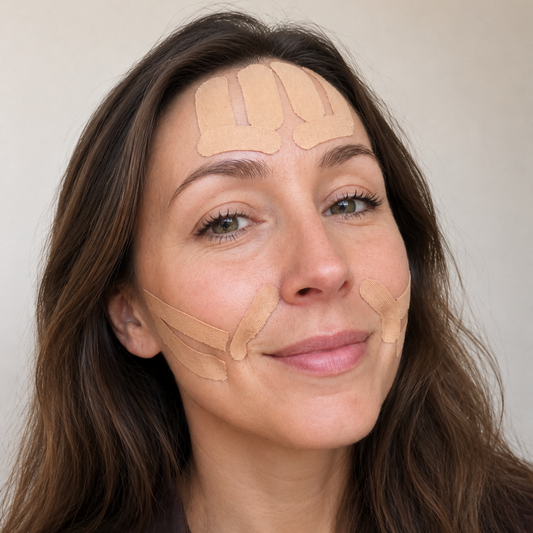
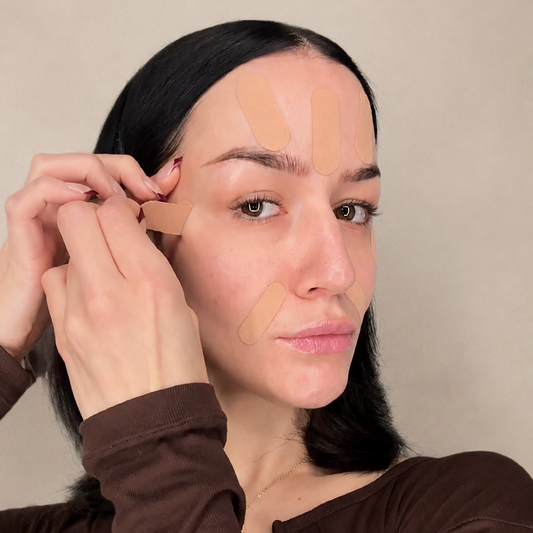
Face taping is a non-invasive evening ritual that uses soft kinesiology tape to support your skin and facial muscles over time, and when it comes to tension, the tape works in three ways:
1. A lift that relieves pressure. The tape lifts the skin slightly and creates extra space between the skin and the tissue beneath, which eases pressure on the muscles and can help relieve tension, tension headaches and clenched jaws.
2. Less movement while you wear it. With the tape on, it's harder to frown, pull your brows together or tense your forehead, so the muscles get to rest. And when you do start to clench or frown, you feel the tape pull lightly on your skin, a small signal that makes you aware of tension you otherwise wouldn't have noticed.
3. New muscle memory for the future. Night after night, the muscles get used to a more relaxed resting position, and over time they're retrained to move less and stay relaxed, even after the tape comes off. That's why regular use makes the biggest difference.
Research on kinesiology tape for the face is still young, but what there is points in the same direction. In a randomised study from 2024, 64 women with jaw stiffness and pain did either jaw exercises alone or jaw exercises together with kinesiology tape over the masseter. After twelve days, the taped group had less pain and could open their mouths wider than the group who only did the exercises. The study was small and short, and the researchers themselves call for more studies, but it supports what many people experience: that the tape can be a complement when the jaw needs help letting go.
While application for the face would benefit from more research, Kinesiology tape for the body has long been used in sports and rehab, where athletes often tape muscles and joints, and there’s a large body of research on taping the rest of the body. Face taping is based on the same method, with a tape and adhesive made for the sensitive skin on the face.
Most people wear the tape overnight, but it works just as well for a while during the day, for example at the computer when working from home, where many of us tense our foreheads and clench the most.
Where to tape to release tension
- The forehead, where tension headaches often sit and where we tense up when we concentrate.
- Between the brows, where we draw the muscles together when we think, read or squint at the screen.
- Along the jaw, over the masseter, if you clench or often wake up with a tired jaw.
- Around the eyes, where many of us squint after a long day at the screen.
The HOLLI Pre-Cut Face Tape Kit has ready-cut pieces in two sizes, with the smaller ones for between the brows and around the eyes and the larger ones for the forehead. For the jaw, the Face Tape Roll works well, as you can cut a longer piece that follows the muscle, and if you have sensitive skin we recommend one of our infused kits with hyaluronic acid or copper peptide in the adhesive. You'll find step-by-step instructions under the method and in our guide What is face taping, and how does it work?
When your jaw needs more help
If your teeth are wearing down quickly, if your jaw often clicks, catches or locks, or if you regularly wake up with pain in your jaw or temples, it's worth asking your doctor or dentist to take a look. A dentist can spot signs of clenching or grinding and, if needed, make you a night guard, a thin plastic splint you wear at night that protects your teeth and takes load off your jaw muscles. There are also specific jaw exercise programmes your dentist can go through with you, and everything you do yourself with breathing, massage and tape works well alongside them.
Common questions about facial tension
Why does my face feel tense?
Usually because the muscles in your face and jaw keep working when they should be resting, often together with tension in your neck and shoulders. Stress, concentration, screen time, clenching during the day or at night, neck tension and too little sleep are common causes, and it's often a combination of several.
How do I relax my jaw?
Let your teeth rest slightly apart and your tongue lie softly in your mouth, and remind yourself to "drop your chin". Humming an M helps the jaw find a relaxed position, and warmth, massaging the masseter and slow breathing help the muscles let go.
Should my teeth touch when my mouth is at rest?
No. Your teeth should only touch when you eat or swallow, and the rest of the time there should be a small gap of a few millimetres between them.
Can jaw tension cause headaches?
Yes. Clenching can cause a dull ache in the temple or across the forehead, and tension in the jaw easily spreads to the temporalis and the forehead.
Why do I wake up with a sore jaw?
A common reason is clenching or grinding in your sleep, which stress, worry and alcohol can all play a part in. Signs can include a tired jaw, tender teeth or an ache in the temples first thing in the morning.
What is buccal massage?
A massage technique where the masseter and the cheek muscles are worked both from the outside and from inside the mouth. It's usually done by a trained therapist, but a simple version with clean hands and soft pressure is something you can do yourself.
Can face tape help with a tight jaw?
Yes, many people tape along the jaw, over the masseter, to help the muscles relax. The lift can help ease the tension, and the tape also makes you aware of when you're clenching.
Where should I put face tape for tension?
On the forehead, between the brows, along the jaw and around the eyes, depending on where you hold your tension. Many people start with the forehead and between the brows, and add the jaw if they clench.
Where can I buy face tape?
The full HOLLI range is at heyholli.com, including pre-cut kits, rolls and bundles.
Facial tension in short
Facial tension is your muscles' way of carrying the day with them, and since it's largely a habit, it's something they can unlearn. With a relaxed resting position for your jaw, slow breathing, warmth and massage, and face taping as part of your evening ritual, you can help your face let go and wake up feeling both more rested and more relaxed. If you'd like to know how tension connects to lines in the skin, read on in Can facial tension cause wrinkles?